
Start a Florence Resident Search
A Florence residents directory question is usually narrower than it sounds. For a parcel, start with the County property route or map and keep the situs address separate from the tax-bill mailing address. For an old household, use a dated city directory, newspaper, census schedule, or deed trail. A court index can show that a name appears in a case, while a vital-record request has its own eligibility rules. Each record supplies a limited fact, not a full profile of a person or home.
Use a name spelling, street number, approximate date, parcel identifier, or case number to keep a search focused. A missing result can reflect a different custodian, an older record series, a protected record, or a spelling change. It is not proof that someone never lived in Florence.
- Use a known address or parcel clue to identify the property record and its situs field.
- Follow a deed reference through the Register of Deeds when the question concerns title or a recorded party.
- For a person verifying their own registration, use the State Election Commission’s individual check.
- Move to the South Carolina Room for a dated household, directory year, newspaper notice, or family-history lead.
- Ask the custodian for a targeted record when the needed material has no public search screen.
Florence Resident Records Desks
Three offices anchor most Florence residents directory research. The Tax Assessor and GIS tools connect a property to its parcel and owner fields. The Register of Deeds holds the recorded deed, plat, mortgage, and lien trail. The elections office has a separate, controlled voter-record channel. They answer different questions, and neither an owner field nor a voter status screen supplies a household list. The full address workflow belongs on the Florence street directory page.
Florence County Register of Deeds
180 N. Irby Street
Florence, SC 29501
843-665-3032
Florence County Voter Registration
219 Third Loop Road
Florence, SC 29505
843-665-3094
Note: Call the office that holds the record before seeking a certified copy, correction, fee, or records-request procedure.
Florence Parcel Clues and Names
A Florence property card can be the best first document when an address is known. It may display a parcel or map identifier, situs address, owner name, legal description, assessed values, a deed reference, and a mailing address. The last field needs care. It tells the tax office where a bill is sent, not who presently occupies the building. Legal-residence treatment is also a tax classification, not a list of every adult at the address.
The County Tax Inquiry is the fully inspected alternative when the vendor-hosted assessor form changes. Its street search is explicitly a billing-address route and may not find the lot or property. A map/block/parcel identifier is the stronger bridge to a property card, GIS feature, and recorded document. Keep a result’s displayed year in the research notes because the tax route’s available years and legacy labels can differ.
- Parcel
- A mapped unit of land used for assessment and record routing.
- Situs address
- The physical location of the property, distinct from a tax mailing address.
- Legal description
- The lot, block, subdivision, or metes-and-bounds text that ties a deed to land.
- Index
- A finding aid that points to a record; it is not always the record image itself.
Florence Deed Names by Date
The Florence Real Estate Look Up form searches parties to recorded instruments. Its first useful pass can include the displayed option to search a name as either grantor or grantee, then narrow by document category, date, legal description, Book/Page, or instrument number. The result is evidence of a recorded transaction. It does not establish that the named party lived at the property on the recording date.
Florence has a specific older-record caveat: the Register of Deeds form treats dates before 1997 at year precision. Do not assume a day-and-month filter will precisely narrow an older title question. The form also offers older deed, mortgage, and plat groups, but it does not publish a simple online-image start year. Take a citation to the ROD counter when the image, date, or record completeness matters.
Search names without unnecessary punctuation assumptions. The form normalizes alphabetic name strings and can sort results by date or name. That small interface detail is useful when an older surname uses spacing, punctuation, or a leading article.
Florence Voter Checks Are Personal
The state’s registration tool is a Florence resident lookup only for a person checking an individual record. It requires a county selection, first name, last name, date of birth, and the last four digits of a Social Security number. It is not a by-street browser and cannot be used to build a neighbor list. South Carolina has no party registration, so a party label is not a result field to expect.
The MySCVotes verification screen shows the individual inputs used for the state process.
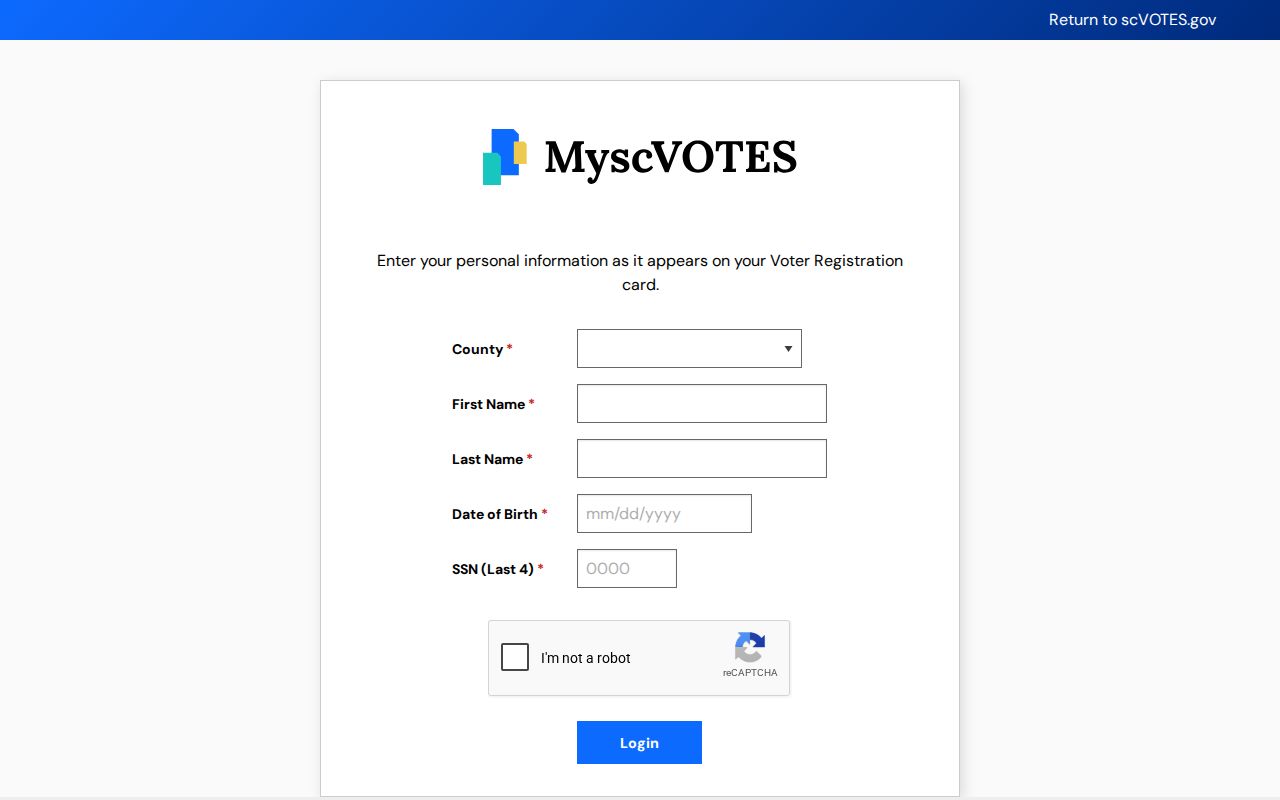
The screen reinforces why an address, name, and personal verification are not interchangeable. A properly authorized voter-list request follows a different state process and restrictions, which must be checked with the election authority.
Current Florence Resident Directory Sources
Current Florence directory-like sources are best read as separate rolls. The property record is about a parcel and owner field. Court records are case-based. The voter channel is controlled. Business and professional systems can confirm an affiliation, but a registered-agent or credential address is not a home address. Match the source to the question before making a request.
| Florence source | What it can show | Custodian | Access boundary |
|---|---|---|---|
| Property card and Tax Inquiry | Parcel, owner, situs, mailing and assessment fields | Tax Assessor | Property evidence, not occupancy |
| Recorded-document index | Grantor, grantee, document type, date, and citation | Register of Deeds | Transaction party, not residency |
| Individual registration check | Personal voter-information verification | State Election Commission | Not a public street browse |
| Court public index | Party, case, court, and docket connection | Judicial Branch and clerk | Sealed and restricted files vary |
| Library collections | Dated directory, newspaper, yearbook, and census context | Florence County Library System | Historical evidence, not present status |
A name that needs confirmation across these boundaries calls for the focused workflow on the Florence resident lookup page, rather than broad searching through unrelated systems.
Florence Court and Vital Routes
Courts, Probate, and vital records each keep a different kind of fact. The South Carolina Case Records Search and legacy Public Index are party-and-case tools, not a complete biography. Probate can be the correct route for an estate, guardian, conservator, or marriage-license question. DPH Vital Records controls birth, death, marriage-certificate, and divorce-report access under record-specific rules. A court decree is not the same thing as a DPH report.
South Carolina Case Records Search is the current court-search entry point used for Florence County filtering where the live service permits it.
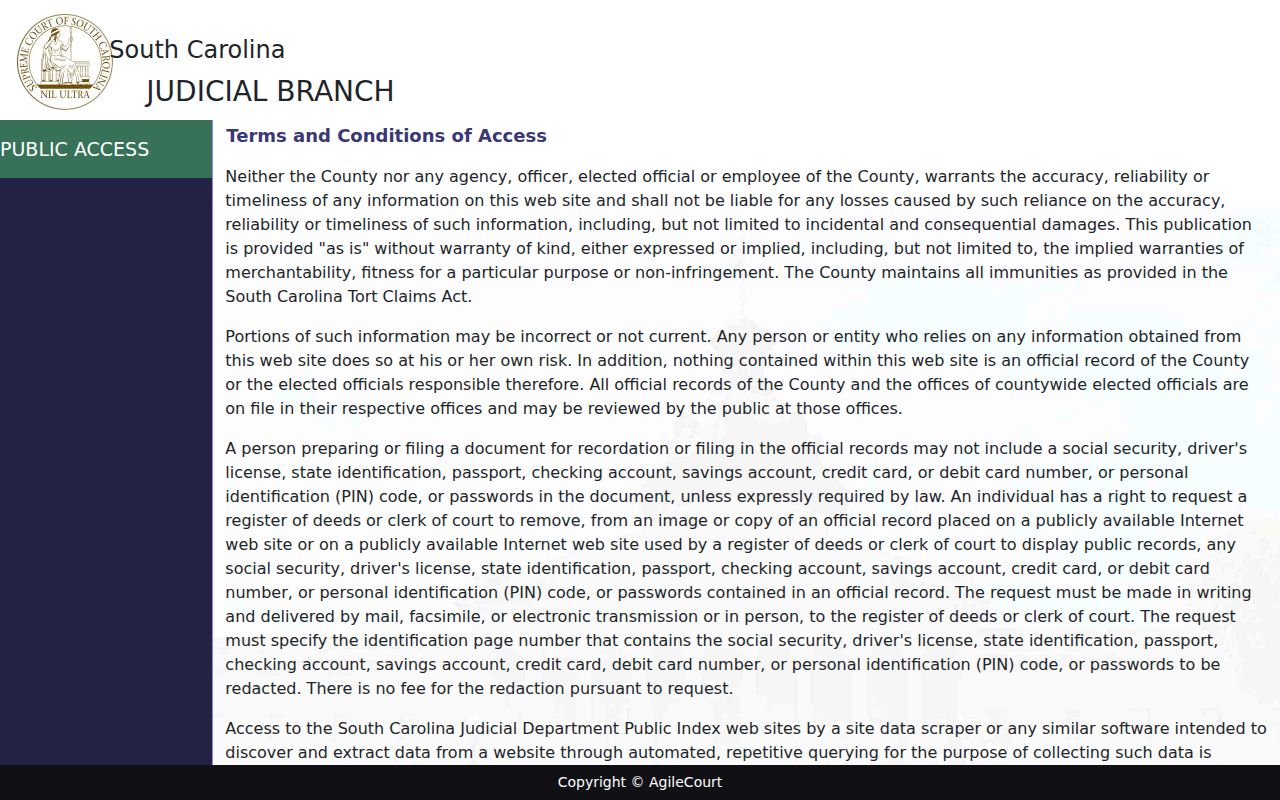
Use a court number, court, date, middle initial, or other lawful context to avoid a same-name mistake. The clerk or court that holds a file controls any copy, sealed-file, and certification question.
For a vital event, use the record-specific channel instead of a general records request. South Carolina birth and death registration begins statewide in 1915. DPH’s marriage-certificate series covers July 1950 through December 2023, while its divorce-report series covers July 1962 through December 2023. A later marriage license belongs with Florence County Probate, and a divorce decree belongs with the court that entered it. DPH’s Florence office, mail instructions, and current online or telephone ordering route are access choices for an eligible requester, not alternate ways to browse other people’s records.
Florence City Records Request Route
Some local address records have no consumer search box. The City Clerk of Council keeps permanent City records, while City Building Inspections and Permits can hold address-keyed material within City limits. For City-held records, Florence accepts an online FOIA request, a mailed request to the City Manager’s Office, hand delivery, or an in-person request. Ask for an identified category, department, address or parcel, and date range. A request does not require staff to create a list of residents.
Florence’s online FOIA request page publishes the City procedure and its local charge schedule.
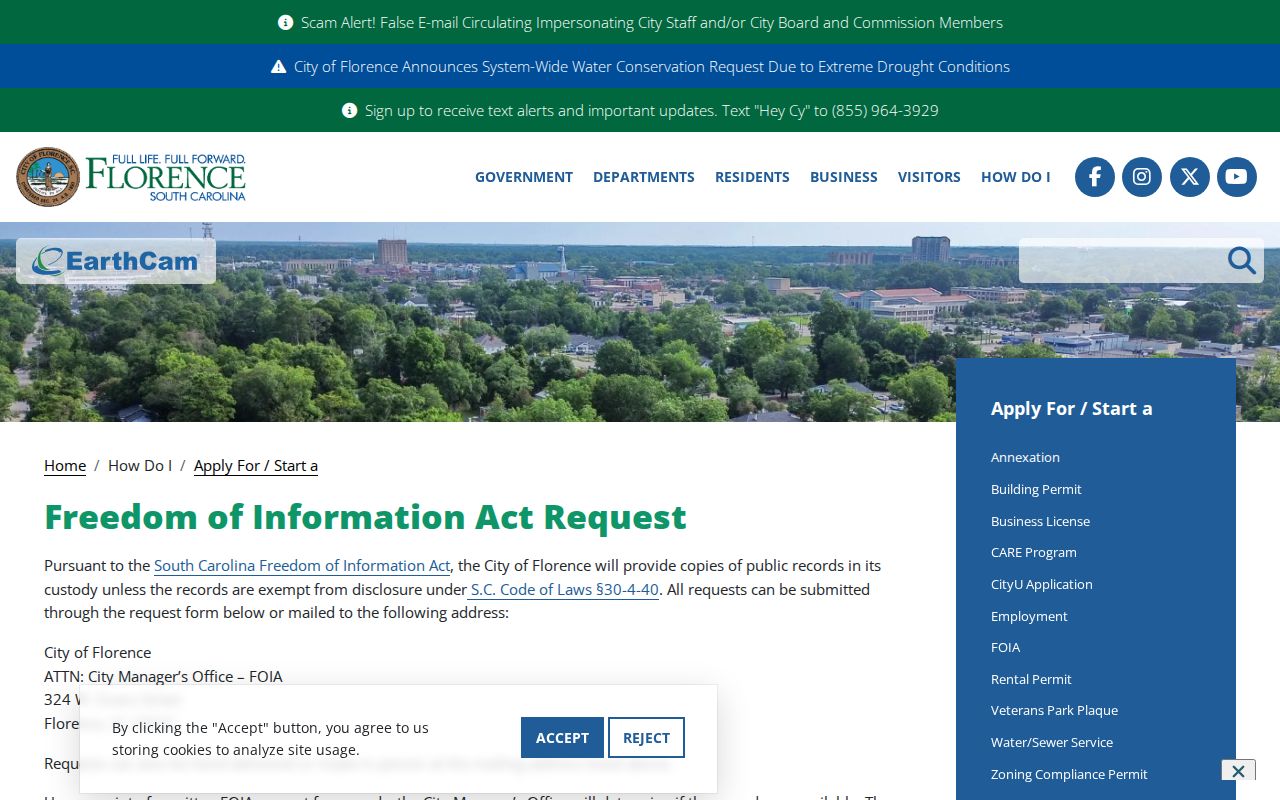
The City says it may charge $0.35 per paper page and a qualified staff-time rate beginning at $20 per hour, may request a 25% deposit, and charges no paper-copy fee for electronic delivery. South Carolina FOIA deadlines and exemptions still govern the response.
Note: County Planning, Sheriff, DPH, courts, and the Register of Deeds have separate channels, so route each request to its actual custodian.
Florence Historical Resident Directories
The E. N. Zeigler South Carolina History Room at Florence County Library System reports Florence City Directories from 1892 to the present, with some issues missing. That qualified statement matters. A directory year can place a printed household or work address in a particular edition, but it cannot prove continuous residence or fill a missing volume. Florence County directories are separately reported for 1967, 1969, and 1997 to the present.
Ask the South Carolina Room for the specific city-directory year, telephone book, possible reverse section, newspaper, yearbook, or genealogy source that fits the question. The full collection and entry-reading process is kept on the Florence city directory page.
A historical entry should be read exactly as printed. Record its title page, edition year, page or column, name form, address, and abbreviation key. A spouse notation, occupation, widow label, or street abbreviation can vary by publisher and cannot be filled in from another volume.
Florence Starts Elsewhere Before 1888
Florence County was formed in 1888 from Clarendon, Darlington, Marion, and Williamsburg counties. That change is the key local history rule for an older Florence residents directory search. An address or family before 1888 may belong in a parent-county jurisdiction even when the modern mailing address says Florence. The South Carolina Room holds parent-county material through 1890, and SCDAH’s Florence County guide identifies later county series.
Use the jurisdiction, not just the current city name, to choose a record book. SCDAH lists conveyance books beginning in 1889, while its guide also notes later plats, estate papers, marriage books, court records, and other county series. These are research paths by series and date, not a single public name search.
Florence Booking and License Limits
Some official results are especially easy to overread. A Florence County booking search is about current custody, not a complete criminal history or a Florence address. A state professional-license result can verify a credential status, but it does not establish a private residence. Keep these narrow systems tied to their purpose and compare names with independent, relevant records.
The Florence County Sheriff inmate search is a current booking route and includes a disclaimer about accuracy and the presumption of innocence.
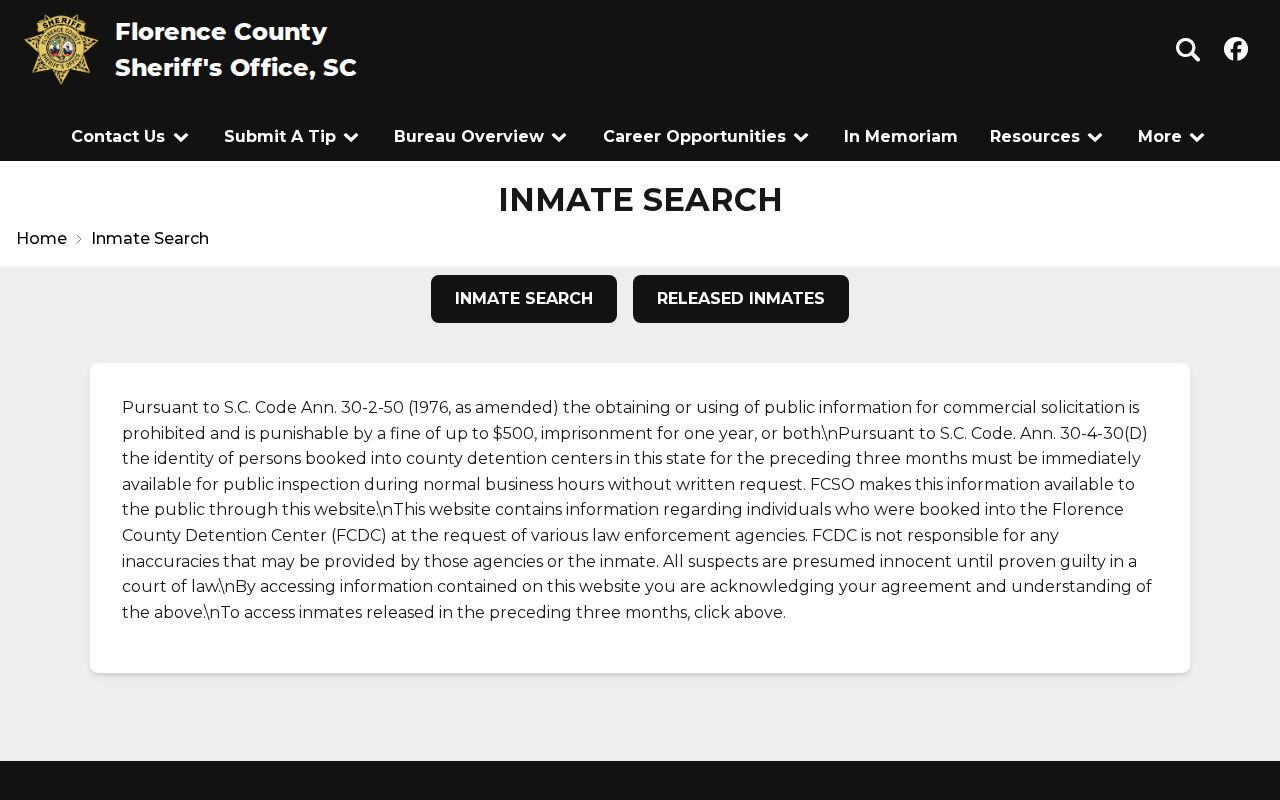
A booking display must never be rewritten as a conviction statement or a current-residence claim. File questions belong with the responsible court or detention authority.
South Carolina LLR’s license lookup is another official, limited-purpose tool.
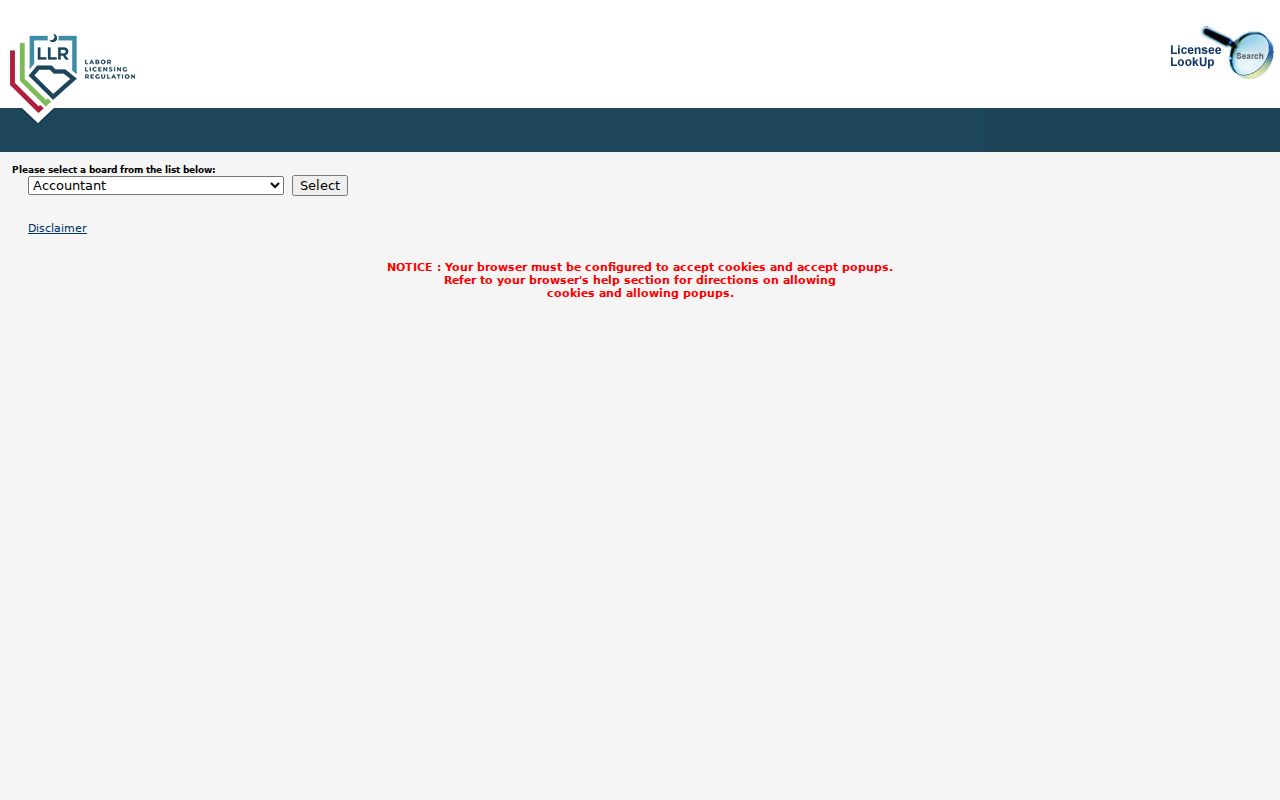
Its board-specific name or license criteria can help distinguish a professional record, yet a business or credential result remains an affiliation record rather than a household roll.
Florence ZIPs Need Address Context
Florence ZIP codes are delivery geography, not resident geography or a City-boundary test. The local address data identifies 29501, 29505, and 29506 as primary Florence delivery ZIPs, but Countywide Florence mailing combinations also appear with 29161 and 29541. The City GIS can show an address point, parcel, street range, City Limits field, and annexation context. USPS then verifies delivery for the single address.
County E-911 assigns local property and building numbers. USPS does not assign that local street address. Preserve the historic street number, current situs or FULLADDR, and legal description when comparing records across time. A ZIP result cannot identify who owns, lives at, votes from, or receives mail at a location.
Florence Records Need Custodian Checks
Official records can be incomplete, delayed, redacted, misindexed, or held in a different office. South Carolina protects vital records, protected addresses, some court records, library use, Social Security numbers, and other sensitive data. A requester who sees a discrepancy should contact the custodian, preserve the citation, and ask about its correction or copy procedure rather than combining several weak matches.
For deed-copy letters, court-payment demands, or urgent claims about a record, use the phone number or link on the official custodian’s page rather than a number supplied by the message. Florence ROD’s Property Check option is an alert service for a selected name or property, not evidence that fraud occurred. Careful source checking protects both the researcher and the person named in a record.
South Carolina’s Address Confidentiality Program can supply an eligible participant with a substitute mailing address. It does not invite a searcher to work backward from other records, and it does not signal that an address should be pursued. Public image rules also provide a route to ask the clerk or Register of Deeds to remove specified sensitive identifiers from an online image. Give the custodian the exact record citation and applicable protection, not unnecessary personal data.
Historical access has its own boundary. Noncertified birth inspection or copies can become public after 100 years, and death records after 50 years, under the state’s vital-record rules. A library obituary, cemetery reference, or newspaper notice can help identify a date or relationship, but it does not replace the official record or prove current household membership.