
Florence City Directory Runs at Zeigler
The E. N. Zeigler South Carolina History Room is the primary local starting point for historic volumes. Its holdings page reports Florence City Directories from 1892 to the present, with some issues missing. That wording matters. It confirms a long run without pretending every annual issue survives or that each year was printed. The room separately lists Florence County Directories for 1967, 1969, and 1997 to the present, which are useful county context but not a continuous substitute for the city series.
| Florence collection | Known coverage | Where it is held | How to use it |
|---|---|---|---|
| Municipal directory run | 1892 to present, with gaps | E. N. Zeigler South Carolina History Room | Ask staff which edition and section are available |
| County directories | 1967, 1969, 1997 to present | South Carolina Room | Use as county-level context, not a complete run |
| U.S. City Directories | Florence 1913 is an identified lead | FCLS in-library Ancestry Library Edition | Inspect the page image and title page |
| Morning News microfilm | 1924 to 2018 | South Carolina Room | Pair dated notices and obituaries with a directory entry |
The room also holds deeds, plats, marriage records, estate papers, family histories, cemetery surveys, yearbooks, and county genealogy sources. Those companion materials can test a directory lead without turning it into a claim about continuous residence. Note: Ask for a specific name, address, and year because the library's genealogy request service is designed for narrow, dated questions.
Florence City Directory Desk Access
The South Carolina Room is at the Florence County Library, 509 South Dargan Street. Its direct contact is 843-413-7060 and scroom@florencelibrary.org. Main-library hours listed by the library are Monday through Thursday, 9 a.m. to 7 p.m.; Friday, 9 a.m. to 5:30 p.m.; and Saturday, 9 a.m. to 1 p.m. The library also publishes a Genealogy Reference Request form. Provide a name variant, an address if known, a date span, and the source you want checked rather than asking staff to identify every past occupant.
The South Carolina Room holdings page is the best confirmation point before a trip. It documents no-cost, in-library access to Ancestry Library Edition and HeritageQuest. HeritageQuest supplies census, family-record, and local-history research tools, while Ancestry access is a library service rather than a promise of remote access from every device.
For a remote question, use the library's research pages first and identify the exact source needed. The South Carolina Room's online local-history material is a discovery layer, while its Ancestry Library Edition access is expressly in-library. HeritageQuest is available through FCLS for census, family records, and local histories, but its current access display controls. The incomplete Swampfox indexes can supply a newspaper lead, not a complete result. Staff article requests are limited to three and need a title, complete date, and page. If that citation is incomplete, consult the Morning News microfilm or ask for the library reference route. A surname paired with an edition or year is a focused request that fits the gaps in the Florence run.
The Florence South Carolina Room collection page shown below is a discovery route, so confirm the edition, condition, and reference rules with staff before relying on a volume.
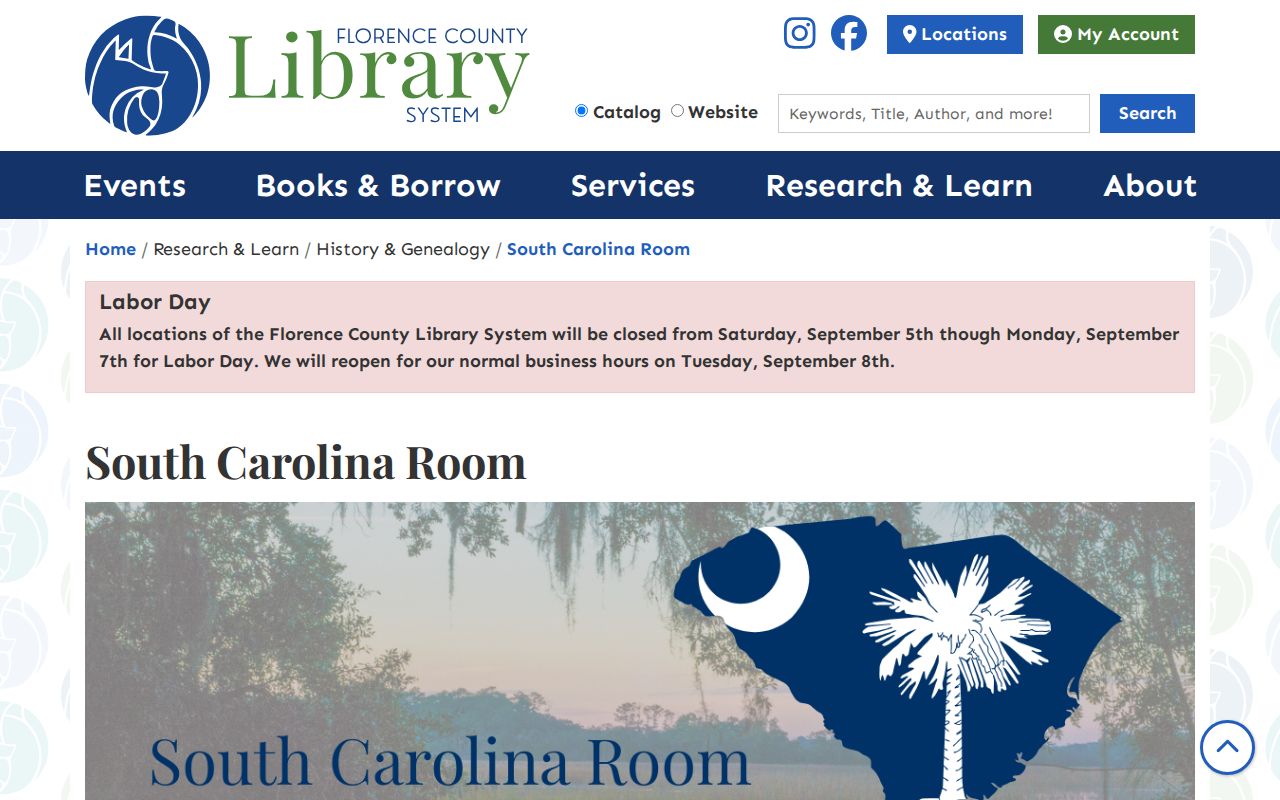
The South Carolina Room adds the local shelf, staff contact, and newspaper access that a digitized image alone cannot provide.
Florence City Directories Before 1888
Florence County was formed in 1888 from Clarendon, Darlington, Marion, and Williamsburg counties. That change sets a firm boundary for historical directory work. A pre-1888 address or surname connected to present-day Florence may belong in a parent-county jurisdiction rather than a Florence County record book. The South Carolina Room keeps material for those parent counties through 1890, so it is a practical place to ask where the jurisdiction changed.
The South Carolina Department of Archives and History also maintains a county-formation reference and a Florence County records guide. Its verified Florence series include conveyance books beginning in 1889, Probate estate papers from 1888 to 1916, and plat books from 1895 to 1992. These are series and reel-based research leads, not a one-click directory. They are especially helpful when a person disappears from an early local volume.
Reading a Florence City Directory Entry
Open the exact Florence volume before copying anything. The local holdings page does not publish a universal field list or a publisher-by-year catalog, so a field must be transcribed only if it is visibly printed in that edition. Start by recording the directory title, year, publisher shown on the title page, page or column, and the holding location or stable image link. Then read the volume's front-matter abbreviation key before interpreting initials, street abbreviations, or household labels.
| Identity | Copy the surname, given name or initials, and any spouse or widow notation exactly as printed. |
|---|---|
| Placement | Record the edition year, title page information, page or column, and whether it is alphabetical, street, or reverse material. |
| Address | Transcribe the street name and number as printed. Do not silently modernize either one. |
| Other fields | Occupation, employer, telephone, and owner or renter marks belong in notes only when the page visibly supplies them. |
| Limitation | A publisher's canvass is a dated listing, not legal proof of residence on every day of that year. |
- Criss-cross directory
- An address-to-name section, separate from the alphabetical listings. The Florence Room's city run makes it worth asking about, but no complete local reverse-directory run was verified.
- Householder index
- A listing organized around a household or address. Its fields and scope differ by volume.
- Abbreviation key
- The front-matter guide that explains the specific publisher's marks. Photograph or transcribe it before interpreting an entry.
When an entry leaves a question open, preserve that uncertainty. An initial-only entry, a woman listed under a spouse convention, and a shortened street name can all require a second source.
Florence City Directory Images Online
The U.S. City Directories collection identifies a Florence 1913 directory as a collection lead. Florence County Library System makes its Ancestry Library Edition available inside the library. Use the image where access permits, then verify the title page, edition, page, and image context before citing a result. A collection search result is not proof that every Florence volume has been digitized.
The U.S. City Directories collection screen below points to a digitized Florence route. Check the image itself, not just a search-result transcription, because the image carries the edition and printed context.
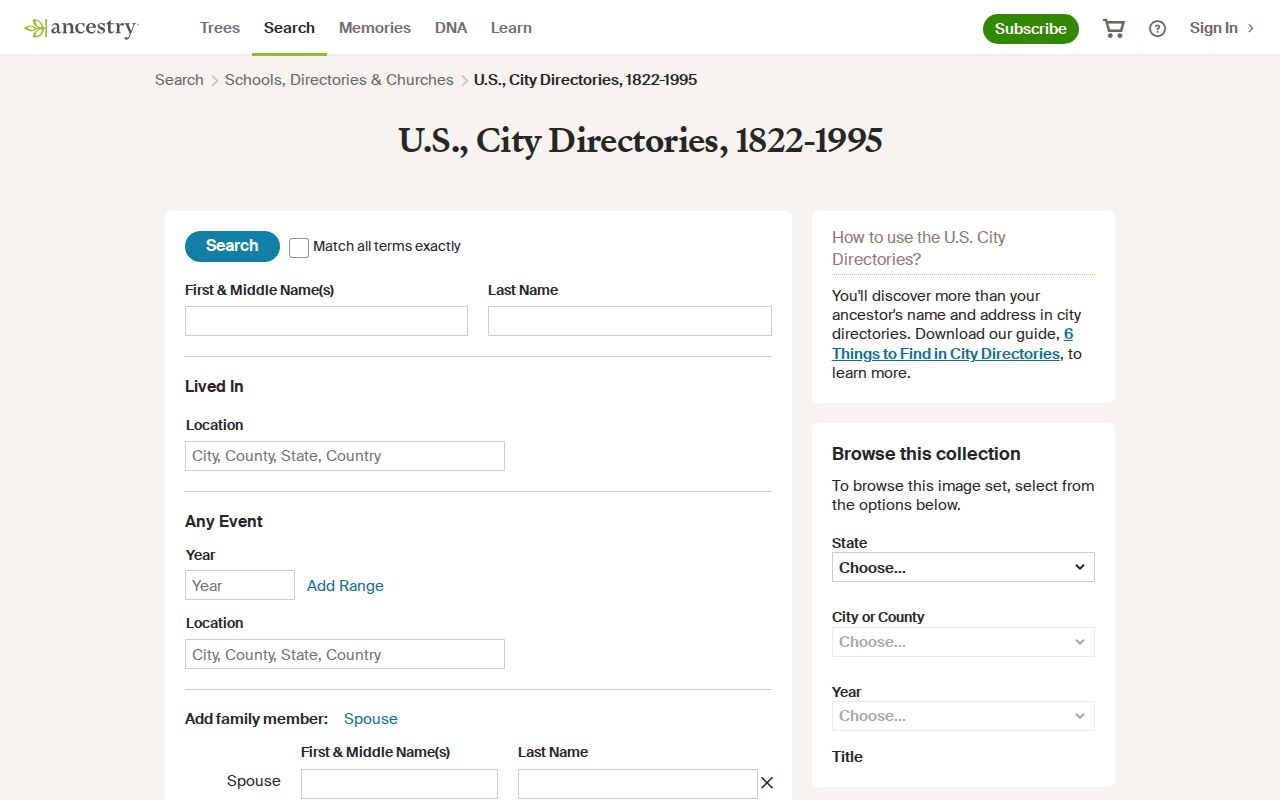
The digital lead works best beside the local shelf: staff can help determine whether a missing online year is present in a physical Florence volume.
Florence Directory Years on Maps
Florence has a long Sanborn map sequence: 1884, 1888, 1893, 1898, 1903, 1908, 1912, 1918, 1924, 1947, and 1952. The Library of Congress 1903 Florence map record illustrates the series. These fire-insurance maps show street labels and building footprint, material, and use for the areas mapped. They do not name every occupant or cover every rural property.
Match a directory year to the nearest map edition. Preserve the older street number and name, then compare it with the current parcel card, plat, and deed legal description before treating two addresses as the same place. City and County GIS layers can add current street and annexation context, but map labels are reference material rather than legal title proof. Note: A different number or street spelling is a reason to investigate, not a reason to merge two historical households.
The newspaper layer can add a date to the same trail. The Florence Morning News is available on microfilm for 1924 to 2018, and the Morning News Digital Archive begins in October 2018. The incomplete Swampfox indexes are leads only; a limited staff article request needs a title, complete date, and page.
Trace Families Through Florence City Directories
A household trail works best when each Florence edition is treated as one dated observation. Start with a current verified parcel or a known directory entry, then move a year at a time. Record the spelling, address, work or spouse notation that appears in the original. Pair a directory year with the nearest released federal census schedule. The federal release rule means 1950 is the newest named census available now, and a census remains a household snapshot rather than proof of address ownership.
- Find the earliest confirmed name in an available Florence edition and save the edition and page reference.
- Check successive available editions, noting a changed address, spelling, occupation, spouse notation, or widow notation only when printed.
- Ask whether that edition has a street guide or a reverse section, then compare the address carefully.
- Match the date to a released census, newspaper notice, obituary, probate file, or cemetery source as appropriate.
- At a move or death point, use deed grantor-grantee progression and estate material to test the next step.
A missing listing can mean a move, a death, a changed name form, an unlisted household, or a missing directory issue. It does not settle the reason alone. For a current address-keyed chain rather than a historical shelf, use the Florence Street Directory route to move from a parcel toward official property records.
Florence City Directory Evidence Limits
Historical volumes are strongest when their limits remain visible. They may omit an issue, use initials, change publisher practice, or list a business address beside a home address. A street sequence can be separate from the alphabetical listing. A reverse section should never be assumed until the exact Florence volume is open. The title page and abbreviation key are part of the evidence, not decoration.
Use current records only for the question they actually answer. A map can identify parcel context, a deed can document a title event, and a directory can place a printed name at an address in a particular period. None of those sources proves every household member or identifies a protected address. Careful Florence research keeps the edition, page, source, and uncertainty together.