
Florence Previous Residents by Era
One Florence address can leave different kinds of evidence in different years. A current Florence parcel record and a deed establish the property anchor. A Florence directory or census entry can place a household there at a point in time. Newspaper, map, permit, and estate material can fill a gap, but none replaces the other. For a Florence address, the strongest result is a dated sequence with the source and its limits recorded beside each entry.
| Address source | Local era | Access point | What it can establish |
|---|---|---|---|
| Florence city directories | 1892 to present, with missing issues | Florence County Library System South Carolina Room | Dated address and household-style entries |
| Florence County directories | 1967, 1969, 1997 to present | Florence County Library System South Carolina Room | County directory context, not a continuous run |
| Florence ROD online system | Current index; pre-1997 dates are year-only | Online search and Florence ROD counter | Recorded title chain and citations |
| Federal population census | Named schedules through 1950 | National Archives and Florence library databases | Household snapshot for its census date |
| Florence Morning News | 1924 to 2018 microfilm; October 2018 onward digital | Florence County Library System South Carolina Room | Obituaries, notices, and local reports |
| Sanborn maps | 1884, 1888, 1893, 1898, 1903, 1908, 1912, 1918, 1924, 1947, 1952 | Library of Congress | Street and building context, not occupants |
| Permit and estate files | Case or record specific | City of Florence, County Planning, or Probate | Change dates or an estate trail |
Begin at the newest reliable point, then work back one document or dated listing at a time. The E. N. Zeigler South Carolina History Room provides the Florence library route, while the Florence Register of Deeds, City of Florence, Florence County Planning, Florence County Probate, and SCDAH provide counter or archival routes when the web record ends.
Florence ROD Date Precision
The Florence Real Estate Look Up form searches indexed property records, but its own help warns that dates before 1997 are recorded at year precision. A day and month filter is therefore not a reliable way to narrow an older title search. Use the broad party search first, preserve the Book/Page or instrument citation from a result, and ask the Florence Register of Deeds for the official book, image, or copy when the online result is unclear or missing.
| Standard search | Uses alphabetic party names and normalizes spaces and punctuation. |
|---|---|
| Sort type | Date or Name. |
| Either-party option | Searches an entered name as either grantor or grantee. |
| Category | Optional document-category selection; start broad before narrowing. |
| Dates | Optional mm/dd/yyyy fields; pre-1997 entries resolve to year-only precision. |
| Book/Page route | Choose an instrument group, then enter Book and Page, or use an instrument/file number. |
The Florence ROD-linked Property Check enrollment page is an additional monitoring lead for a chosen name or property, subject to its current enrollment terms.
An alert can help surface a later instrument recorded in Florence County. It does not prove a fraud event, establish a household, or replace a review of the recorded document.
Florence Previous Residents Deed Chain
Ownership is not the same thing as occupancy, but it gives the address history a durable backbone. The Florence County Tax Inquiry, the Florence County Assessor's property record route, or Florence GIS can supply the parcel/TMS and legal description. Treat the mailing address on a tax record as a delivery field, not proof that its recipient lived at the property. The legal description and earlier Book/Page references are the better match when old address numbers do not line up.
- Capture the current situs address, parcel/TMS, legal description, and current recorded owner from the property record or map.
- Search that owner in the Florence ROD as a grantee, using the either-party option for a broad first pass.
- Open the likely deed and record its instrument number or Book/Page, date, document type, parties, and legal description.
- Search the prior seller as a grantee to find that person's earlier purchase of the same described parcel.
- Repeat the sequence, comparing subdivision, lot, block, plat, and legal-description details at every transfer.
- When an index gap or conflict appears, take the citation to the Florence ROD counter instead of assuming the web index is complete.
- Grantor and grantee
- The grantor conveys an interest in a document; the grantee receives it. Their roles can reverse in the next transaction.
- Chain of title
- The linked sequence of recorded transfers for the same property, read backward from the present record.
- Legal description
- The lot, block, subdivision, plat, or metes-and-bounds description that ties a document to land beyond a street number.
- TMS or MBP
- A county parcel identifier. It is often a steadier property key than an address when tracing old records.
Note: The Florence ROD index names document parties; only a dated directory, census, or comparable record can support an occupancy finding.
Florence Old Index Records
For historical title work, the Florence ROD Old Index Search is more specific than a general instruction to check deed books. It requires an old index book, a Grantor or Grantee choice, and a page number. Its listed groups include deeds for 1889 to 1937 and 1928 to 1937; deed and mortgage groups for 1938 to 1962, 1963 to 1973, and 1974 to 1983; and plats for 1889 to 2003. It complements the live Florence ROD form and the archive microfilm, rather than guaranteeing that every image is online.
The Florence ROD's old-index form shows the book-and-party path used when a modern address fails.
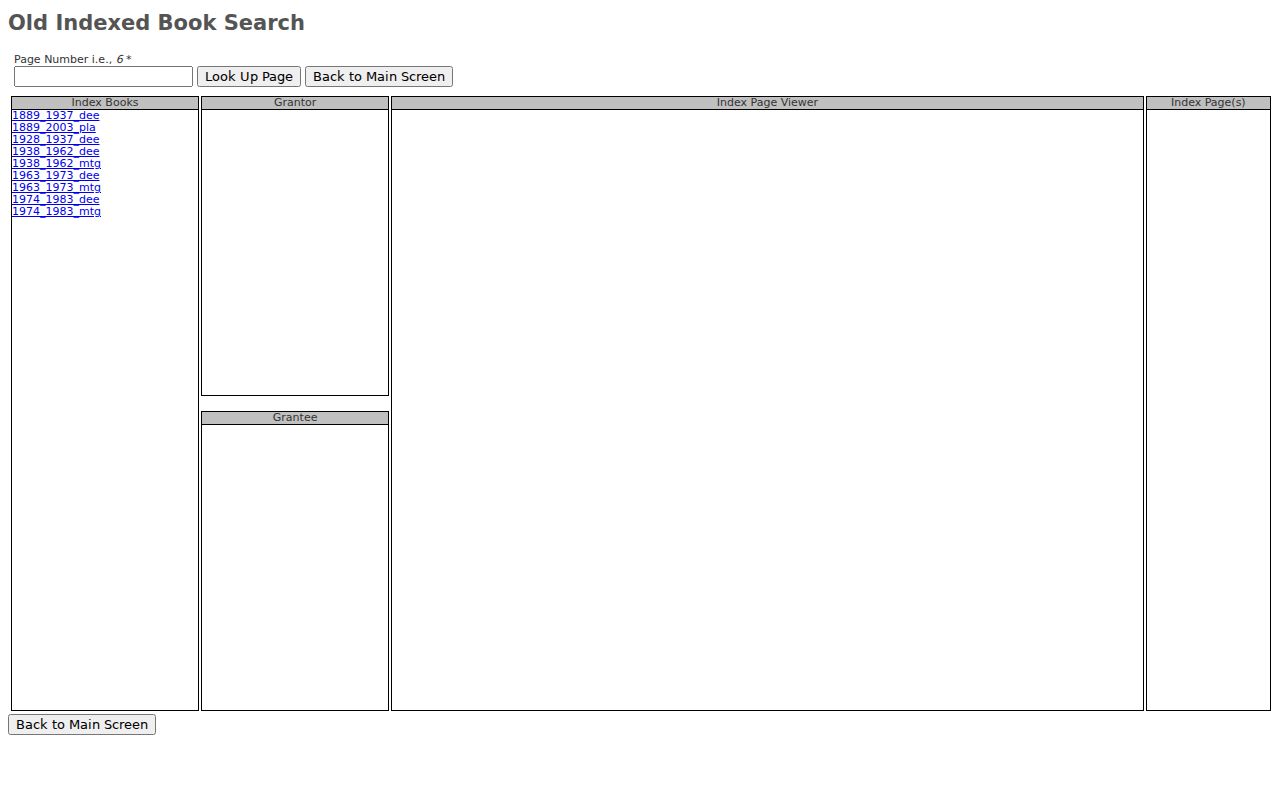
Save the book, page, party role, and date range with each hit. Those details make a later counter or SCDAH request much more precise.
A matching Florence online result is an index lead, not a finished title opinion. Florence ROD detail records can show an instrument number, status, document type, Book/Page, filing date and time, party tables, legal description, subdivision fields, and prior or next book-document links. Compare those fields to the Florence parcel rather than trusting a street number alone. If a document image or a certified record matters, confirm availability, redactions, copy options, and current fees with the Florence ROD.
Florence Before 1888
Florence County was formed in 1888 from Clarendon, Darlington, Marion, and Williamsburg counties. That changes the first question for a very early address trail: check the parent jurisdiction before changing the family name or discarding the address. The SCDAH Florence County records guide identifies conveyance books from 1889 to 1935 on 74 microfilm reels and plat books from 1895 to 1992 on seven reels. The South Carolina Room also keeps parent-county material through 1890, so its desk and the archive are the practical next stops for a pre-county gap.
Note: A Florence mailing place on an 1884 map does not mean the later Florence County office created the original record.
Florence's 1892 Directory Run
The South Carolina Room reports Florence city directories from 1892 to the present, while plainly noting that some issues are missing. It also reports Florence County directories for 1967, 1969, and 1997 to the present. Ask staff whether a year has an alphabetical, street-guide, or reverse section before treating it as an address tool. Copy each printed number and street exactly, together with the edition, page or column, and repository citation. The library's Florence City Directory page focuses on reading those collections and their access routes.
Florence Past Household Records
Deeds can identify a title trail, but dated Florence household records are needed to research who lived here before. Florence directories, a verified reverse listing, and census schedules each have a different time frame and level of detail. Use them as overlapping snapshots, not as a continuous roll of every person at the address.
- Start with the newest dated Florence directory or property record that can be cited.
- Move backward through available directory years, recording the address exactly as printed and noting gaps in the run.
- Check a street guide or reverse directory only after the South Carolina Room confirms that section exists for that edition.
- Pair the directory year with the nearest released federal census schedule. The National Archives release rule makes 1950 the newest named federal census.
- At a move or death point, use the Florence Morning News, Probate, cemetery references, and later directory entries to test the timeline.
The Florence County Library System supplies in-library Ancestry Library Edition and HeritageQuest for census, family-record, and local-history research. Compare initials, name punctuation, and widow notation only as they appear in that Florence volume; do not supply missing details from another year. For a narrow newspaper request, the incomplete Swampfox indexes and the Morning News lead should be reduced to a title, complete date, and page; staff requests are limited to three articles at a time.
Note: A Florence census is a household snapshot for its enumeration date, not proof that one address label stayed unchanged.
Florence Previous Residents, Closing Gaps
The eleven Library of Congress Sanborn editions cover Florence in 1884, 1888, 1893, 1898, 1903, 1908, 1912, 1918, 1924, 1947, and 1952. They show buildings, materials, uses, and street labels for covered areas, not residents. Pair the directory year to its nearest map, then compare it with the present parcel, plat, and deed description. City GIS annexation information can help identify when a parcel entered the City, but no verified citywide renumbering year was found.
For a construction or alteration date, use the Florence County Planning Basic Search for county-jurisdiction files, or seek City-held material through the City FOIA request channel or Building Inspections counter. An obituary may point to relatives, while a Florence County Probate file can identify an estate fiduciary or heirs. Neither is title evidence by itself.
For County Planning, the public Basic Search uses a single “Name, number, address” box. An address search should use the street only, without city, state, ZIP, or unit, and a result identifies a permit, license, project, or violation record rather than a household. City material has no verified public address index, so use the online FOIA form, mail, hand delivery, or an in-person request for identified address files held by the City.
Lawful personal use. Research past residents for house history, family history, estate work, or personal curiosity. Do not use a name or address to stalk, harass, or harm a living person.